

Testicular Cancer
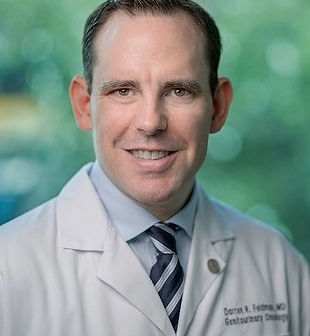
Darren Feldman, MD, Section Head for Germ Cell Tumors (GCTs) within the Genitourinary Oncology Service at Memorial Sloan Kettering Cancer Center.
Darren Feldman, MD, is a medical oncologist who specializes in treating patients with genitourinary cancers. Within the Genitourinary Oncology Service at Memorial Sloan Kettering Cancer Center (MSK), Dr. Feldman is the Section Head for Germ Cell Tumors (GCTs), which are the primary focus of his research, and also leads the stem cell transplantation program for solid tumors. Dr. Feldman harnesses MSK’s global leadership in cancer biology and genetics to develop new therapies that promise effective treatment for patients with advanced, difficult-to-cure GCTs.
GCTs are responsible for over 95% of cases of testicular cancer and are the most common cancers diagnosed in men ages 15 to 40. GCTs occasionally arise in areas around the thoracic or abdominal cavities, even if there is no evidence of cancer in or near the testicle. When GCTs advance following salvage treatment, they are considered incurable because of inadequate treatment options. In an analysis of 90 patients with relapsed/refractory GCTs treated at MSK, the average survival time was just four months. These people are young and in the prime of their lives, magnifying the devastation when a patient succumbs to the disease. A death from GCT results in the greatest number of average life years lost from any adult malignancy. New and improved therapies are urgently needed to change the treatment paradigm for patients with relapsed/refractory GCTs.
Dr. Feldman and colleagues have been working over the past years to develop novel, potentially more sensitive and specific blood tumor marker tests, called microRNA 371a-3p and microRNA 372-3p, to monitor GCT disease status in people whose traditional markers are not elevated. Their goal: an MSK test for research and clinical purposes with a host of potential applications. These include but are not limited to GCT diagnosis, evaluation of response during treatment and for minimal residual disease (microscopic residual GCT not able to be detected by imaging) after completion of treatment, determination of who needs surgery after treatment, and surveillance for recurrence. Dr. Feldman, Dr. Ye, and colleagues recently obtained approval for the MSK MicroRNA Assay (MMA) by the New York State Department of Health, the first approval of its kind in the United States. However, they still need to demonstrate the utility of the assay in specific clinical scenarios such as those listed above in order to introduce the test into standard clinical practice. Philanthropic funding will be key to these efforts.
A more detailed description of the research initiatives can be found here